
Oracle Integration Cloud Gen2, launched in 2019, has established itself as a reliable and sophisticated integration solution for Oracle customers. Following this, Oracle Integration 3 was introduced in 2022, featuring a fully cloud-native architecture that enhances performance, scalability, and user experience. It is specifically engineered to manage more intricate workflows and accommodate elevated integration volumes.
The time has come where you really must take action to upgrade your Oracle Integration instances to avoid service disruption.
Oracle Announcement
From March 20th, 2025, you will no longer be able to provision Oracle Integration Cloud generation 2 instances in your Oracle Cloud console. This decision is part of Oracle’s ongoing commitment to streamline its cloud offerings and improve overall service quality, ensuring that customers can benefit from the latest features and capabilities available in its more advanced services.
This change applies to all commercial and government Oracle Cloud regions.
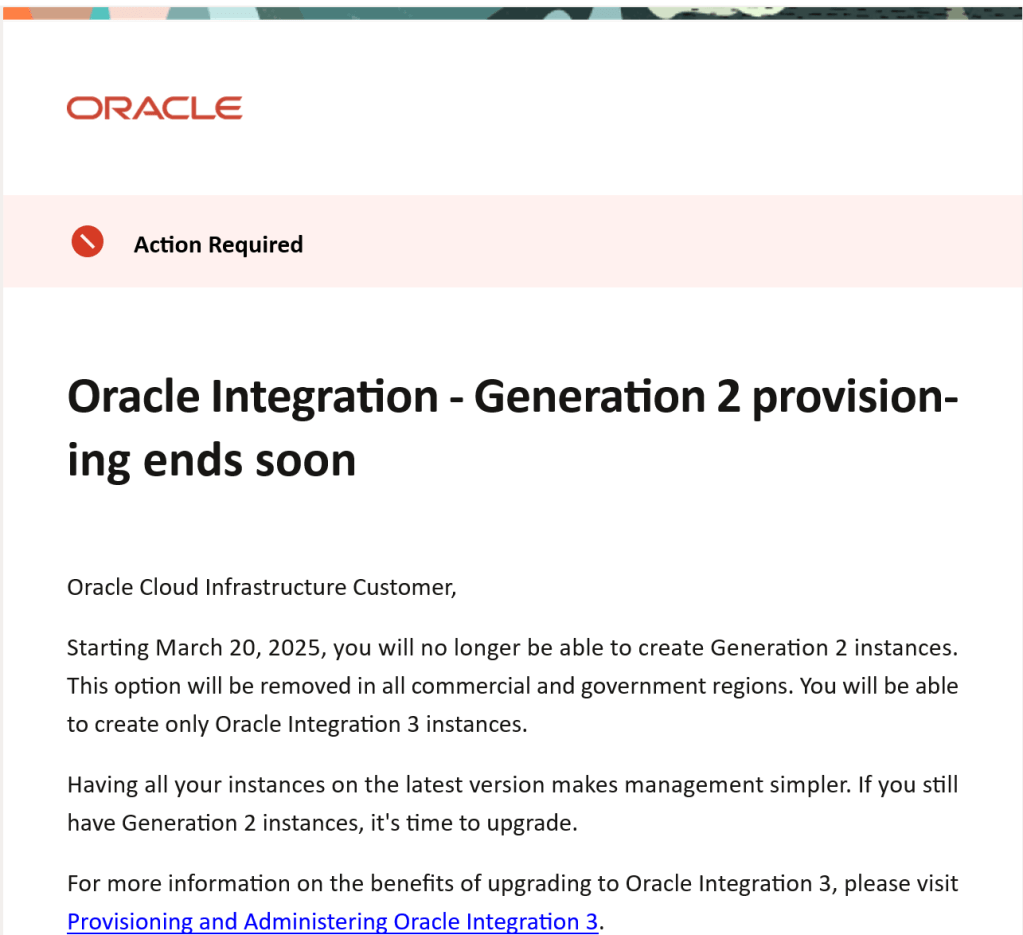
At the time of writing this post, OIC Generation 2 will be deprecated in totality on 31st August 2025 in all Oracle Cloud regions.
Existing Oracle Integration Cloud generation 2 Instances
If you currently have an existing Oracle Integration Cloud gen 2 instance, your administrators will receive an email like the one pictured below:
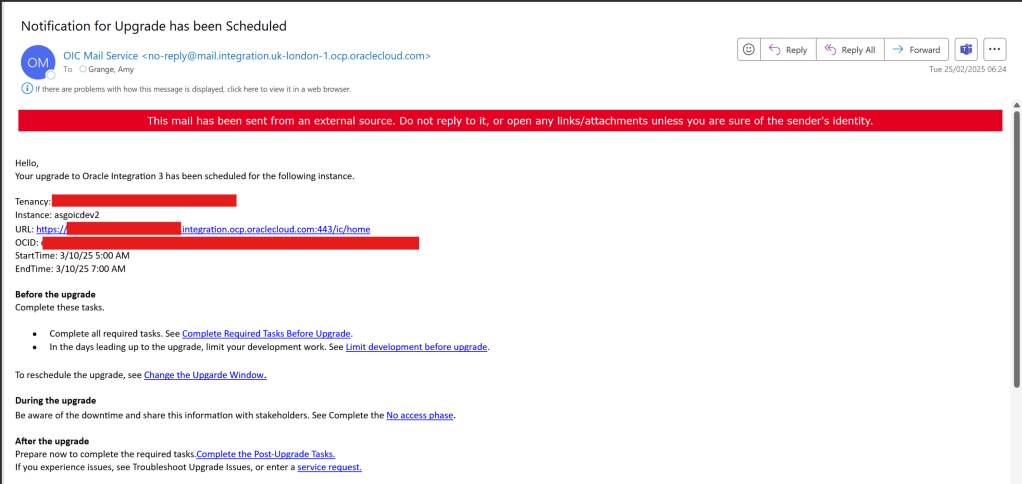
It includes important information on what actions you need to take. Do not ignore!
Within your Oracle Cloud console, you will see “announcements” such as the below:
And in your OIC console, you will see the following banner:

Clicking “Review” or alternatively navigating to “Settings” > “Upgrade”, you will be able to view a summary report which details the ability for your instance to upgrade:

In the above, you can see that my OIC generation 2 instance has an issue on upgrade path with my use of the UiPath connector which is not available in Oracle Integration 3. Any issues identified here must be resolved ahead of upgrading your instance to avoid unwanted consequences and impact to your integration flows.
You can also make amendments to the scheduled upgrade in this screen (within the allowance timeframes noted above).

FAQs
What is Oracle Integration 3?
Oracle Integration 3 is a cloud-native, microservice architecture-based version of Oracle Integration. It delivers improved performance and reliability, as well as significant improvements in provisioning and other lifecycle management activities by more deeply leveraging the power of Oracle Cloud Infrastructure.
Can I choose the date and time for the upgrade?
Yes. You select the date and time for a 60-minute downtime. Oracle completes the upgrade work on your behalf during the downtime.
Can I change my upgrade window?
Yes. You can change your upgrade window up to 3 days before your selected date and time.
How will the upgrade affect my service?
The upgrade is a planned maintenance event that includes scheduled downtime during the upgrade process. Additionally, your service will be affected in the following ways:
- Activity stream data isn’t moved to Oracle Integration 3.
- When the downtime begins as part of the upgrade, Oracle Integration stops accepting incoming requests for actively running synchronous application-driven orchestrated integrations.
For information about how Oracle Integration is affected during and after the upgrade, see How Upgrade Affects Runtime Data.
I have more questions.
If you have questions after reading the Upgrading to Oracle Integration 3 documentation, you should log a service request in My Oracle Support.
 AMY SIMPSON-GRANGE - BLOG
Pingback: Upgrading your Oracle Integration Cloud Gen2 Instance to Oracle Integration 3 | AMY SIMPSON-GRANGE – BLOG
Pingback: Exploring Oracle Integration Cloud: March 2025 - Implementing Oracle Integration Cloud
Pingback: Oracle Integration Cloud has native RPA – WHAT?! | AMY SIMPSON-GRANGE – BLOG